

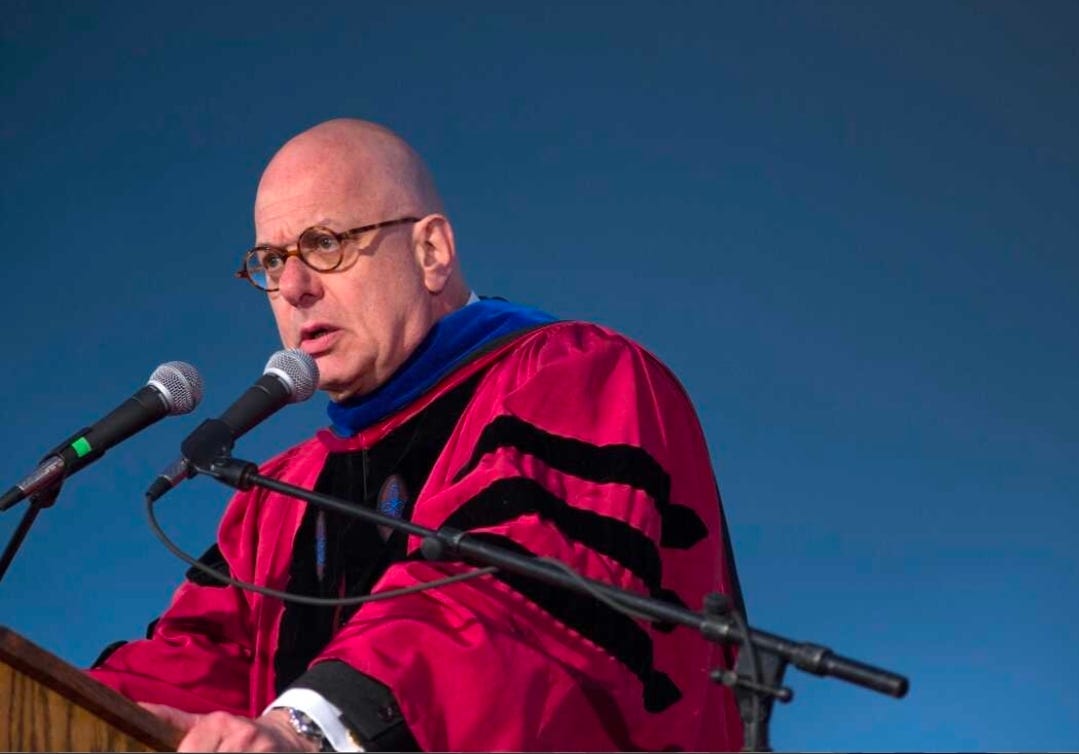
Leon Botstein is stepping down from the presidency of Bard College after an independent review found that his relationship with Jeffrey Epstein was far more extensive than he had publicly acknowledged, and that his repeated interactions with the convicted sex offender could have alerted him to the possibility that he and Bard were helping facilitate Epstein’s access to women.
The review, conducted by the law firm WilmerHale and commissioned by Bard’s board of trustees, found that Botstein made about 25 visits to Epstein’s Manhattan townhouse, took a two-day trip to Epstein’s private island, Little St. James, and hosted two visits by Epstein to Bard. The review also found that some of those interactions included “multiple women” who have since been identified as Epstein victims.
That is not a minor clarification. It is not simply a reputational problem. It is the record of an elite institution’s president repeatedly engaging with Jeffrey Epstein years after Epstein’s sex-offender status was public, while pursuing him as a donor and minimizing the relationship when the scrutiny finally arrived.
Botstein has not been charged with wrongdoing in connection with Epstein. That matters legally. But the question raised by the WilmerHale review is not only whether Botstein committed a crime. The question is how a powerful college president chose to treat Epstein’s presence, money, access, and reputation after the risks were already visible.
According to the review, Botstein and Epstein were in contact from 2012 to 2019. Epstein’s 2008 conviction was not hidden by then. His status was public. His wealth, social access, and continued proximity to elite institutions were part of the very machinery that allowed him to keep moving through respectable spaces long after he should have been treated as a danger.
The review found that Botstein had previously said he was not friends with Epstein. But WilmerHale concluded that his public statements and comments to the Bard community minimized and were not fully accurate in describing the relationship. The visits, invitations, island trip, campus access, and financial interactions make that minimization impossible to dismiss as a matter of wording.
This is where the story becomes larger than one retirement announcement. Institutions helped Jeffrey Epstein convert money into legitimacy. They helped him remain adjacent to power, education, culture, science, philanthropy, and public status. Each invitation, each meeting, each polite engagement, each donor conversation, and each institutional door made Epstein appear less like a convicted predator and more like a man still welcome among the powerful.
That kind of legitimacy had consequences.
WilmerHale’s review found that Botstein failed to consider that his actions could validate and legitimize Epstein to potential victims or their parents. That sentence belongs at the center of the story. Epstein’s danger was not only what he did in private. It was also the public credibility that powerful people and institutions continued to give him. When a college president meets with him repeatedly, hosts him, visits his properties, and pursues his money, it tells the outside world that Epstein remains inside the circle.
That circle mattered.
The review also suggested that Botstein had been warned by a senior faculty member not to engage with Epstein. Instead of heeding that warning, Botstein reportedly relied on the view that “an ordinary sex offender” like Epstein could be presumed rehabilitated because he had served time in prison. The review also found that Botstein forcefully argued that Bard’s need for funds was paramount.
That is the moral collapse at the center of the case.
The issue is not only that Botstein misread Epstein. It is that he treated the possibility of donor money as powerful enough to override warning signs, reputational danger, student risk, and the basic ethical burden of dealing with a known sex offender. The report states that his view was, “I would take money from Satan if it permitted me to do God’s work.”
That line reveals the institutional logic more clearly than any formal statement could.
When institutions convince themselves that their mission is so important that they can take money from almost anyone, they create a permission structure for abuse-adjacent power. They tell themselves the cause is noble enough to sanitize the source. They convert moral compromise into strategic necessity. They treat money as neutral, even when the person offering it is using money to buy access, rehabilitation, and proximity.
Epstein understood that world. He moved through it with precision. He attached himself to universities, scientists, artists, academics, and public intellectuals. He used donations, promises, meetings, and proximity to powerful institutions to rebuild social credibility after his conviction. That credibility did not appear on its own. It was granted.
Bard’s review shows one example of how that granting worked.
Epstein was invited into Bard’s orbit. He visited the campus. He was pursued as a donor. Botstein visited him repeatedly. There were invitations that were not accepted but that could have exposed Bard students to Epstein, including a stay at Bard’s guest cottage, a concert by conservatory students, and a visit to Bard High School Early College. The review found that Botstein did not see a risk to Bard’s reputation in pursuing Epstein or the potential risk to Bard students of exposure to him.
That failure is staggering.
A college president has a duty not only to raise money but to protect the institution’s students, integrity, and moral boundaries. Pursuing a convicted sex offender as a donor while failing to consider the risk to students is not ordinary fundraising. It is a failure of judgment at the level of institutional governance.
The financial questions deepen that failure. WilmerHale’s review found that Botstein accepted fees under a consulting agreement with an Epstein entity in 2016 and did not disclose the agreement to Bard’s board because he intended to donate those funds to Bard. According to the review, Botstein told investigators that the funds were donated by rolling them into his and/or his wife’s contributions over the years and were not separately identified from Epstein.
The review found that, for that reason, the documents could not confirm for the board the contribution of those fees to Bard.
That is not a clean record. It is a foggy one. Consulting fees tied to an Epstein entity, not disclosed to the board at the time, later described as having been folded into personal or family contributions without being separately identified, create exactly the kind of opacity that institutions should not tolerate when dealing with a convicted sex offender.
The board has said funds associated with Epstein will be directed to organizations supporting survivors of sexual harm. That step matters, but it does not erase the underlying issue. The question is not only where the money goes now. The question is why Epstein’s money, access, and invitations were allowed near Bard in the first place.
The board’s response also deserves scrutiny. Bard’s trustees said they received WilmerHale’s findings on April 30 and that Botstein then submitted his “retirement,” effective June 30. The board thanked him for more than five decades of service and called for an orderly transition. It also acknowledged that the concerns raised in recent months were serious and deeply felt.
An orderly transition may be administratively useful. It should not become a soft landing that replaces accountability.
Botstein’s 51 years at Bard are part of the story. His long tenure and influence explain why the institution may be inclined to frame his exit with gratitude and stability. But longevity cannot be allowed to swallow the findings. A five-decade legacy does not cancel out a review showing that the president minimized his relationship with Epstein, ignored warnings, pursued Epstein’s money, accepted consulting fees, and failed to consider how his actions could legitimize Epstein to victims and families.
That record has to remain visible.
Botstein’s own statement did not address WilmerHale’s findings. Instead, he said he had previously informed the board that, in light of his 51 years of service and upcoming 80th birthday, it had been his intention to retire from the presidency. He said he intended to remain a faculty member, teacher, and musician, and would live at Finberg House on Bard’s campus.
That response leaves a major silence. If an independent review finds that a college president minimized his relationship with Jeffrey Epstein and failed to consider how his conduct could validate Epstein, a statement about prior retirement intentions does not answer the ethical questions. It avoids them.
The public should not have to choose between acknowledging Botstein’s long service and recognizing the gravity of the review. Both can be true. He may have shaped Bard for decades, and he may also have made decisions around Epstein that exposed a serious institutional failure. Service does not immunize judgment. Reputation does not erase responsibility.
The deeper question is how many institutions still rely on that kind of immunity.
Epstein’s network survived for so long because powerful people kept treating his presence as manageable. They treated him as complicated, useful, rehabilitated, eccentric, wealthy, or worth tolerating. They treated access to money as a reason to keep doors open. They treated warnings as obstacles instead of alarms. They treated public facts about his conviction as something that could be rationalized away.
That is how institutional protection works. It often does not look like a direct conspiracy. It looks like invitations, meetings, explanations, donor cultivation, private judgment calls, softened public statements, and decisions not to ask too many questions. It looks like people with power deciding that the money, status, or connection is worth the risk.
But the risk was not borne equally. Epstein’s victims carried the consequences. Students and young women were the people who could be exposed. Families could see institutional affiliation as a signal of safety. Bard’s reputation could be used, directly or indirectly, as part of the broader legitimacy Epstein sought after his conviction.
That is why WilmerHale’s finding about legitimization matters so much. Epstein did not only need money. He had money. What he needed was social permission. He needed powerful people to keep taking meetings. He needed institutions to keep opening doors. He needed elite spaces to keep treating him as someone still worth knowing.
Every institution that gave him that permission has a record to answer for.
Bard is now facing that record through the review it commissioned. But accountability cannot stop at releasing a summary and arranging a transition. The college should fully confront how Epstein entered its orbit, who knew what, what warnings were raised, how decisions were made, why the board did not receive certain disclosures, what safeguards failed, and how students and community members will be protected from similar donor-driven failures in the future.
This is not only about Bard. It is about a broader elite culture that allowed Epstein to keep moving through respectable institutions long after his conviction. Universities, museums, philanthropies, scientific circles, and cultural institutions all have to answer the same question: what did powerful people decide to overlook because money was in the room?
The Botstein review shows how dangerous that question remains.
When a college president can make dozens of visits to Epstein’s townhouse, visit Little St. James, invite Epstein into the orbit of a college, accept fees from an Epstein entity, minimize the relationship publicly, and later retire after an independent review, the problem is not just one man’s judgment. It is the structure that made such judgment seem available.
Institutions should not need scandal to discover boundaries. They should not need public pressure to understand that a convicted sex offender seeking proximity to students, campuses, and cultural legitimacy is a danger. They should not treat survivor-centered accountability as something that happens only after reports are published and reputations are already threatened.
Bard’s board now says funds associated with Epstein will go to organizations that support survivors of sexual harm. That is appropriate, but it is also late. Survivors should not have to wait for institutional review processes to validate what was already clear: Epstein used power, money, and elite access to protect himself. Institutions helped make that possible when they continued to treat him as someone worth engaging.
Leon Botstein is stepping down. But the larger record should not step down with him.
The review found more than he admitted. It found a pattern of contact, minimization, warnings, money, and institutional blindness. It found that the pursuit of Epstein’s money could have helped legitimize him to people who needed protection from him. That is the part that must remain in public view.
The issue is not whether Bard can move through an orderly transition.
The issue is whether Bard, and every institution like it, will finally stop treating proximity to predators as a fundraising problem instead of a survivor-safety problem.
Epstein Files Resistance documents the institutions, money networks, and public figures that helped Jeffrey Epstein maintain access, legitimacy, and protection long after his crimes were known.
These stories cannot be reduced to scandal or quiet transitions. They are records of how power protected itself while survivors were left to carry the consequences.
Upgrade to a paid subscription to support independent documentation, investigation, and accountability work.