

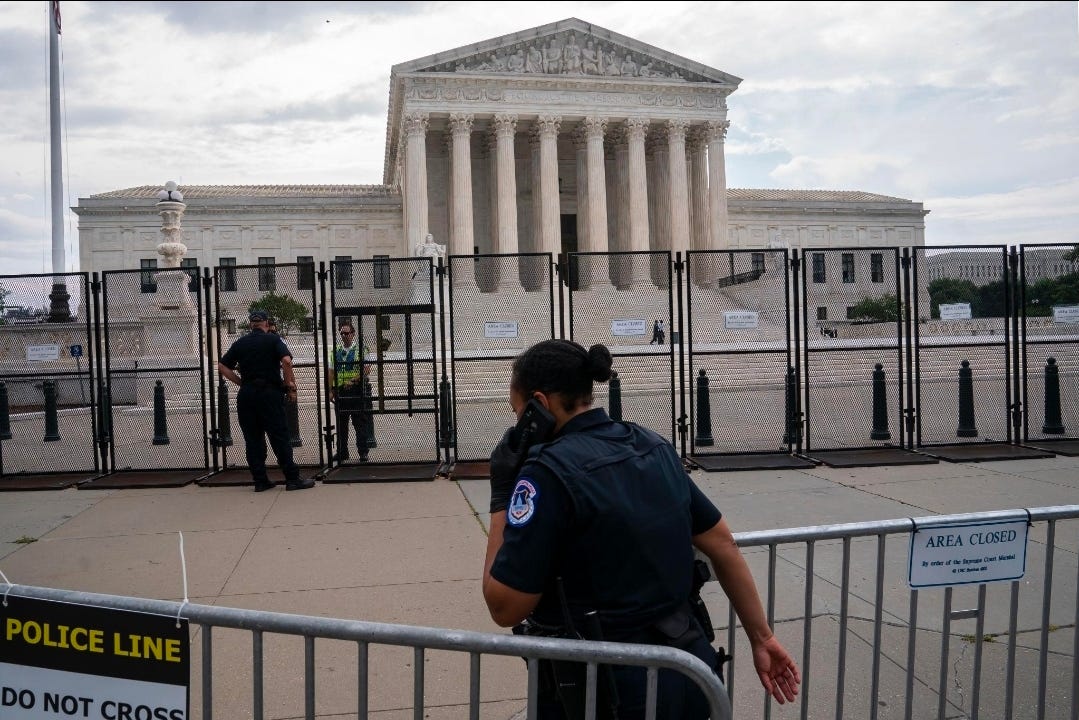
The Supreme Court is asking Congress for approximately $228.4 million for fiscal year 2027: $210.3 million for salaries and operating expenses and $18.1 million for care of the building and grounds. The request covers judicial salaries, Court employees, technology, travel, administration, building maintenance and other operating costs, but a substantial portion of the proposed increase would expand the permanent security structure surrounding the Court and its members.
The Court is seeking $14.6 million and 84 additional full-time positions for personal and building protection. Its proposal would add six protective agents for each justice, 25 officers assigned to the Supreme Court building, four police-administration positions and additional support for security-related travel. It also requests $2 million for another off-site residential-security command post and $2.3 million for 12 cybersecurity employees. The separate building-and-grounds request includes $6.5 million to design an external facility that would screen visitors before they reach the Court’s main entrances.
These are not minor temporary purchases. They are investments in personnel, command infrastructure, cybersecurity and physical separation that would carry continuing costs beyond one budget year. The Court already operates behind its own police department, controlled entrances, surveillance systems, physical barriers and extensive federal protection. Its new request would enlarge that shield.
Justices Elena Kagan and Amy Coney Barrett told Congress that threats against the Court are projected to rise by approximately 38 percent this year after increasing 25 percent the year before. They cited swatting incidents, bomb threats, threats involving family members and the attempted attack near Justice Brett Kavanaugh’s home. Barrett described being sent home in a bulletproof vest and having her family endangered by a false emergency call.
Threats and violence are not accountability. They do not repair harmful rulings, restore lost rights or protect anyone affected by government power. The stronger indictment is that the Court recognizes danger immediately when it reaches the justices, translates that danger into staffing and infrastructure needs, and expects taxpayers to fund an urgent institutional response.
The Court has shown far less urgency when its own interventions expose ordinary people to government action before their cases receive full review. Through emergency stays, procedural rulings and limits on lower-court relief, the justices have repeatedly decided who must carry the risk while the legality of a Trump administration policy remains unresolved. The government is allowed to act. Workers, immigrants, trans people, students and families are left to absorb the consequences.
That pattern was visible in Trump v. CASA, where the Court restricted the use of universal injunctions in challenges to Trump’s executive order attacking birthright citizenship. The Court did not decide whether the order itself complied with the Fourteenth Amendment. It instead limited the authority of lower courts to block enforcement beyond what was necessary to protect the particular plaintiffs before them.
That procedural ruling had direct consequences. Families and children threatened by the same executive action could no longer assume that one lower-court injunction would protect everyone nationwide. Relief became more dependent on who had filed suit, whether a class could be certified, what remedy a court considered necessary and whether affected families had access to lawyers and litigation. The Court treated broad protection against a potentially unconstitutional order as an equity and procedure problem while the people exposed to that order carried the risk.
The same allocation of risk appeared in Trump v. American Federation of Government Employees. The Court stayed a lower-court order restricting the administration’s federal workforce restructuring plans. It allowed the executive order and planning process to proceed while leaving lower courts to examine whether specific agency reductions violated particular statutes.
For federal employees, that distinction was not theoretical. Workers faced layoffs, lost income, interrupted benefits and destabilized careers while litigation continued. Agencies risked losing experienced personnel and institutional knowledge. The public faced disruption to programs and services administered by the workers targeted for removal. A later ruling against a specific reduction cannot fully restore an office that has already been dismantled or the months of income a family has already lost.
In McMahon v. New York, the Court granted the administration’s request to stay a preliminary injunction restricting actions connected to the dismantling of the Department of Education. The order allowed the administration to move forward during the appeal rather than requiring it to preserve the department’s existing capacity until the legal challenge was resolved.
The consequences extend beyond federal employees. The Department of Education administers student-aid systems, oversees grant programs, collects national education data and enforces civil-rights protections relied upon by students, families and school systems. When staff and administrative capacity are removed before final judicial review, a later legal victory may arrive after programs have been disrupted, expertise has been lost and enforcement systems have been weakened. The Court’s intervention placed the risk of institutional damage on the public rather than on the administration seeking disputed authority.
Trans service members faced the same harm-first structure in United States v. Shilling. The Court stayed a preliminary injunction blocking the Trump administration’s ban on trans military service, allowing the policy to operate while the appeal continued. Three justices indicated that they would have denied the government’s request.
For trans service members, the stay exposed careers, income, medical care, retirement plans, professional standing and family stability to immediate disruption. It allowed the federal government to treat trans status and gender-related medical care as grounds for exclusion before the courts had finally resolved the policy’s legality. The Court did not have to issue a final endorsement of the ban to give the administration the power to begin imposing its consequences.
The Court again intervened in Trump v. Orr, granting the administration’s request to stay an injunction against its passport policy. The policy requires newly issued passports to display the government’s classification of a person’s sex at birth rather than the marker requested by trans, nonbinary and intersex applicants. The order allowed that policy to operate while the case continued.
The resulting harm includes identification that discloses or misrepresents a person’s identity, increased exposure during travel and document checks, delayed applications and barriers to employment, medical care, education and family travel. The Court treated those risks as burdens the affected people could carry during litigation while granting the administration immediate authority to enforce the policy.
These cases concern different legal questions. CASA addressed the scope of equitable relief. AFGE involved federal workforce restructuring. McMahon involved the Department of Education. Shilling concerned trans military service. Orr concerned passport identification. The pattern connecting them is the Court’s control over immediate risk.
The Trump administration acted. A lower court imposed a restriction. The Supreme Court intervened before full review and allowed the policy or restructuring to proceed. The government obtained immediate freedom of action while workers, children, trans people, students, families and public institutions absorbed consequences that could become difficult or impossible to reverse.
This is why the Court’s security request cannot be examined as though it were disconnected from the power the justices exercise. Through emergency stays and procedural orders, the Court decides whether the government must pause or whether the public must endure the policy while the legal system continues deliberating. The justices understand that exposure can become irreversible harm. Their own budget is built around preventing that possibility before it materializes.
The budget translates risk into material responses: more protective agents, more building officers, more residential coordination, more cybersecurity staff, expanded travel protection and a new screening facility. The Court does not tell the justices to wait until a threat becomes an attack before receiving protection. It seeks intervention in advance.
Ordinary people deserve the same recognition of irreversible harm. A federal worker cannot automatically recover the stability lost during an unlawful dismissal. A public agency cannot instantly rebuild years of expertise after mass removals. A trans service member cannot necessarily restore a military career interrupted by exclusion. A person denied usable identification cannot recover every missed journey, job opportunity, medical appointment or family event. A child’s constitutional protection should not depend on whether their family can quickly enter the correct lawsuit.
The Court nevertheless has repeatedly permitted these consequences to begin while the law remains contested. It gives the administration the benefit of immediate action and assigns the public the burden of surviving that action until the courts reach a final answer.
The taxpayers being asked to finance the Court’s protection include the same people living under these decisions. They include federal workers facing job loss, students relying on public education programs, immigrants confronting detention and deportation, trans people targeted by federal policy, families carrying medical debt, people struggling with food and housing costs, and communities seeking protection from government power.
They are being asked to fund additional agents, officers, command posts, cybersecurity teams and screening barriers for an institution whose interventions have repeatedly increased their own exposure to immediate harm.
Expanded protection also increases the Court’s institutional distance from the public consequences of its work. More barriers, screening, residential security, controlled travel and guarded access can protect the justices physically while further insulating them from the people living under their decisions. The public pays for the shield while remaining outside it.
The entire $228.4 million request is not a security budget. It also covers employees, technology, records, administration and building operations. That does not place the security expansion beyond scrutiny.
Congress should require a precise accounting of how many positions are being created, how each increase responds to documented risk, what the long-term cost of the new protective structure will be, what oversight governs residential and travel security, how the cybersecurity expansion will be measured and what the proposed visitor-screening facility will ultimately cost beyond its $6.5 million design phase.
The Court is entitled to submit a budget request. The public is entitled to examine the priorities and conduct of the institution requesting the money.
The Supreme Court wants more taxpayer money to expand the protection surrounding an institution whose power has generated deep public anger. The people financing that protection have every right to demand accountability for the immediate harm the Court has allowed the Trump administration to impose while litigation continues.
Powerful institutions repeatedly demand greater protection and insulation for themselves while ordinary people are left to absorb the consequences of their decisions.
Share this report to demand a full accounting of the Supreme Court’s funding request and public accountability for the human harm enabled by the power it exercises.
Expand the court
Fuck em…as the great George Carlin would say….. go investigate what happened to your moral integrity you assholes….